
Ezzy Mast FAQ's
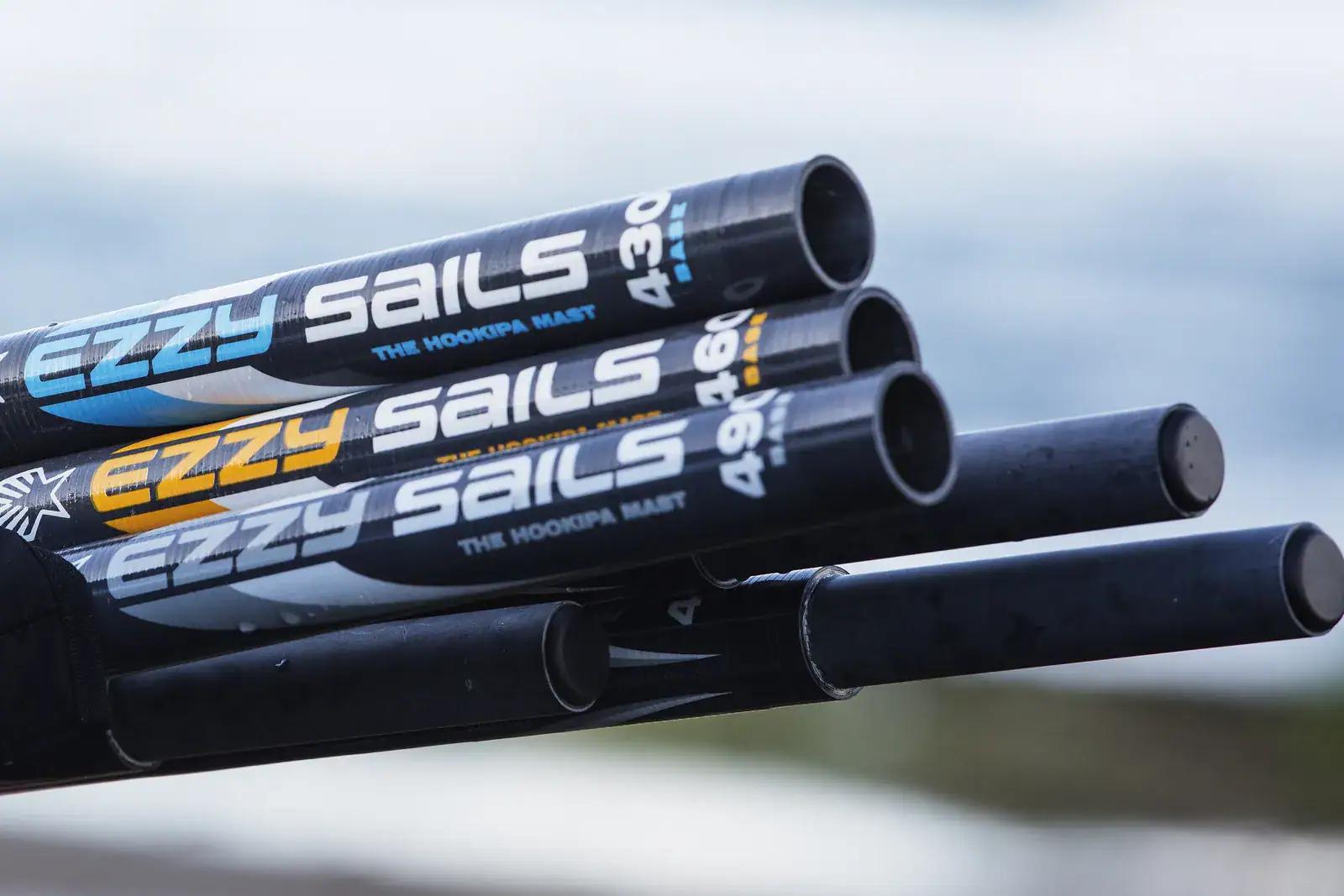
The 60% carbon mast
Is the Legacy XT 60% carbon mast interchangeable with the Hookipa 91% carbon mast?
Yes.
Does the 60% carbon mast work well in all Ezzy Sails, past and present?
Yes.
Is the bend curve and stiffness of the 60% carbon mast the same as the 91% carbon mast?
Yes.
Is the 60% carbon mast softer than the 91% carbon mast?
No. Same as the 91%.
Is the 60% carbon mast as strong as the 91% carbon mast?
Yes.
What does the 60% carbon mast feel like compared with the 91%?
The 60% feels pretty good. I only notice the difference when I go back on the 91%, which still feels better to me because it is lighter.
Will you stop producing the 91% carbon masts in the future?
No. We will continue with both the 60% and the 91% masts.
Using masts with Ezzy Sails
Do Ezzy Sails work on SDM masts?
Yes. Ezzy Sails are designed to fit on both standard diameter and reduced diameter masts.
How do I know if my non-Ezzy mast will work with Ezzy Sails?
Ezzy Sails will fit on most mast brands. Some brands will work better than others. If your mast is a standard constant curve bend, it will work on our sails.
What are the bend characteristics of Ezzy masts?
Ezzy masts have a traditional constant curve bend: ¼ point 62%, ¾ point 77%. Our bend curves have not changed since the early 90s, so older sails will also work well with our masts.
What should I ask my shop about a non-Ezzy mast?
Ask what the bend curve is. I am not referring to MCS or IMCS. I am referring to the bend characteristic of the upper and lower section relative to the middle.
For a mast to work well with Ezzy Sails it should have:
- ¼ point = 61 to 64%
- ¾ point = 75 to 79%
In a nutshell, what schools of thought are out there with bend characteristics?
There are two bend curves commonly found in masts:
- Traditional constant curve, like ours: ¼ point 62%, ¾ point 77%.
- Softer bottom, stiffer tip: ¼ point 65–66%, ¾ point 73–75%.
Which masts work with Ezzy Sails, and which ones don't work so well?
Stiffer tip masts are not the best with Ezzy Sails. These masts don't allow the sail to twist correctly. Most constant curve masts work well.
Mix and Match
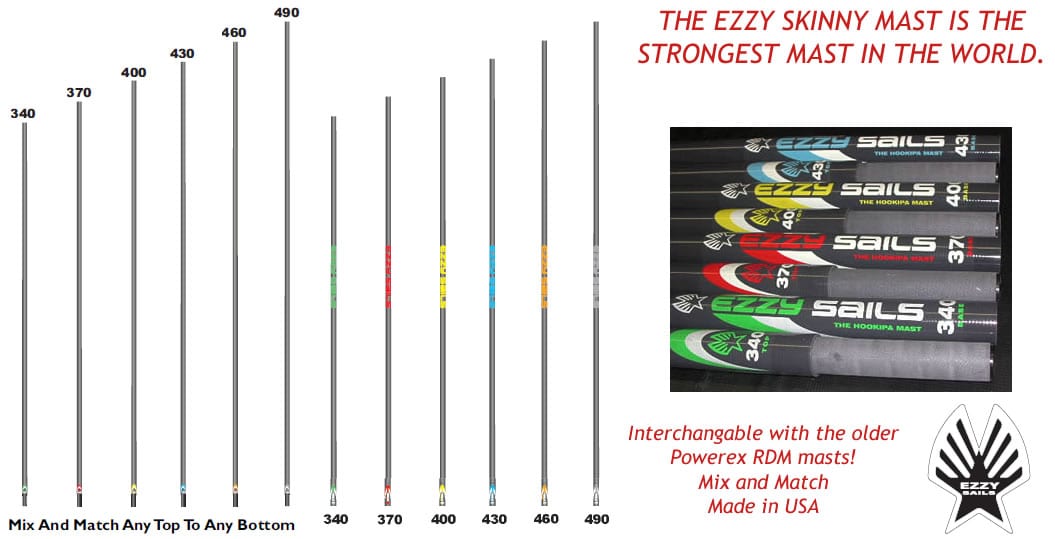
Tell me about the Mix and Match system.
Smaller sails require softer masts. This is true for all windsurfing sails. If the mast is too stiff, the sail feels rigid and twitchy.
Mix and Match allows you to use a shorter, more flexible bottom to get better performance and handling.
It also helps people who are on a budget. It allows them to purchase just a top or a bottom to suit their sail needs.
How far can you push the Mix and Match system? Can you mix a really long top with a really short bottom?
We suggest going up or down just one size, however a lot of our customers report that going up or down two sizes works well.
In order to keep the bend curves compatible, it is important that the bottom is the same size as the top, or shorter.
Why an Ezzy mast
Why is it important to use an Ezzy mast with Ezzy Sails?
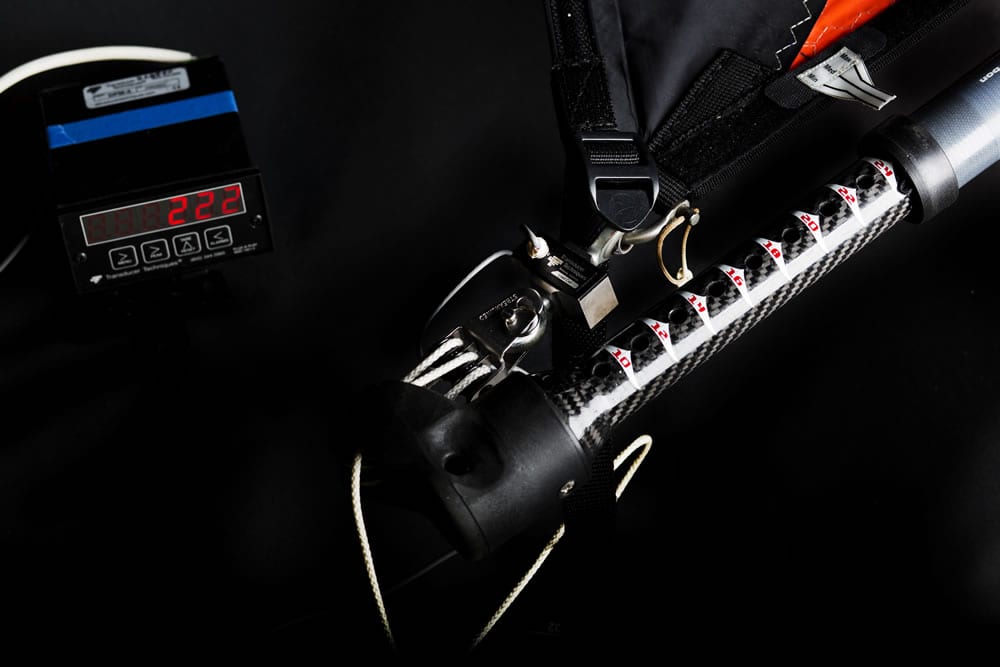
All our sails have our calibrated downhaul system.
Each sail is rigged in the factory using a load cell, a highly sensitive gauge that measures the downhaul force. After setting the downhaul with the load cell, we affix a gauge that lines up with the bottom of the mast.
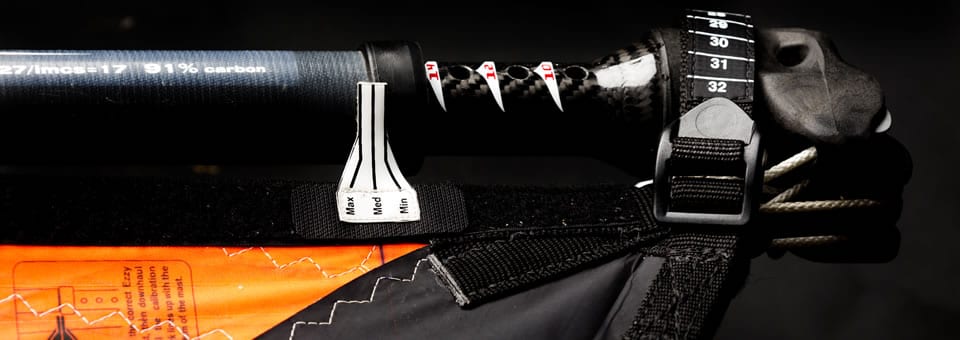
So all the customer has to do is downhaul until the gauge lines up with the bottom of the mast.
This system only works if the mast is the same length and bend curve as our masts. Masts from other brands are not always the correct length and may have different bend curves.
Is it really worth getting an Ezzy mast, or can I get by with the mast I have?
If you want the maximum performance from your Ezzy sail, get the correct Ezzy mast.
It is hard to tell with other brands. Some might be okay and some not. If the length is correct and the bend curve and stiffness are correct, it should work in your Ezzy sail.
Our sails have visual downhaul indicators that will help you set the downhaul for non-Ezzy masts.
Why should I buy an Ezzy mast?
- Works perfectly with Ezzy Sails and most other sail brands.
- Incredibly strong. It will last 20 years or more.
- Mix and Match system.
- Excellent warranty.
- Great track record. We were the first sail company to sell a skinny mast. We launched the Ezzy skinny mast in 1999.
MCS and IMCS
What do MCS and IMCS stand for?
MCS stands for Mast Check System. The MCS number tells you how stiff a mast is.
The MCS is obtained by supporting the mast 5.0 cm in from either end and hanging a 30 kg weight in the center of the mast. The maximum deflection is measured and divided into the length of the mast. That means a 520 mast with an MCS of 27 bends 19.26 cm when 30 kg of weight is suspended from the center. So the higher the MCS number, the stiffer the mast.
The problem with the MCS number is that it is specific to masts of the same length only. A 460 with an MCS of 25 is stiffer than a 400 with an MCS of 25.
IMCS stands for Indexed MCS. It allows you to compare the stiffness of masts of different lengths. In effect, the IMCS says: if you stretched or shrunk your mast to a 460, this is what the MCS would be. That is why a 430 with an MCS of 25 has an IMCS of 22, and why a 460 with an MCS of 25 has an IMCS of 25.
This is how you calculate it:
IMCS = mast length³ ÷ (midpoint deflection × 460²)
The IMCS and the MCS only tell part of the story. They say nothing about the bend curve. To describe the bend curve, you divide the ¼ point deflection into the midpoint deflection and come up with a percentage. You do the same for the ¾ point. The ¼ point and the ¾ point are halfway from the midpoint to the bottom and halfway from the midpoint to the top respectively.